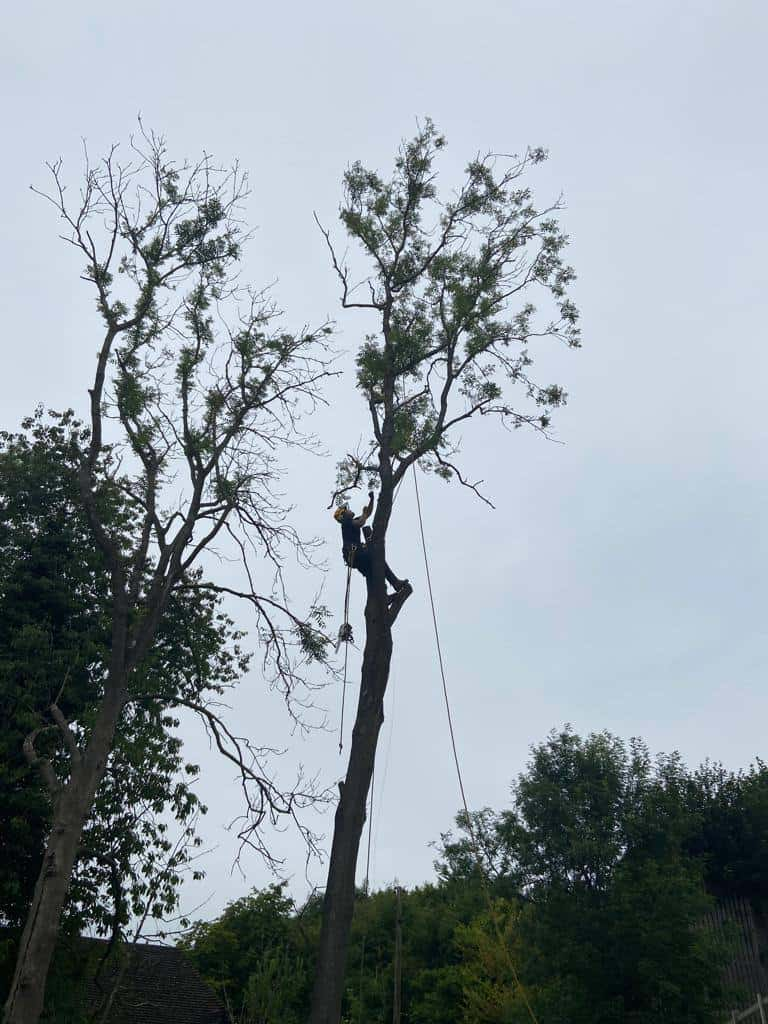
A mature tree can be an attractive and valuable feature within a garden, but its size can gradually become difficult to accommodate. As the crown expands, branches may extend over lawns, paths, driveways or other parts of the property, while the overall canopy can begin to dominate the available outdoor space.
For property owners in Felixstowe, Suffolk, crown reduction can provide an effective way to manage an oversized tree without automatically resorting to removal. When professionally planned and carried out correctly, it can reduce the height or spread of the canopy while retaining the tree’s natural form and healthy structure.
What Is Crown Reduction?
Crown reduction is a tree surgery technique used to decrease the overall dimensions of a tree’s canopy.
Rather than simply cutting branches back indiscriminately, selected branches are shortened to suitable growth points. The aim is to create a smaller, balanced crown while maintaining an appropriate framework of healthy branches.
Depending on the individual tree, crown reduction may focus on:
- Reducing overall canopy spread
- Managing excessive height
- Shortening overextended branches
- Improving the balance of the crown
- Creating additional clearance
- Bringing the tree into better proportion with its surroundings
The amount of reduction should always be appropriate for the species, maturity and condition of the tree.
Why Do Large Trees Become Difficult to Manage?
A tree that once fitted comfortably within a garden can eventually become much more dominant as it matures.
Branches may gradually spread across increasingly large areas, while a dense canopy can influence light levels and restrict how parts of the garden are used.
Common concerns can include:
- Branches extending too far across the garden
- Growth becoming increasingly close to property features
- Excessive shading
- An unbalanced or overly broad canopy
- Large branches becoming difficult to accommodate
- The tree appearing disproportionately large for its setting
These issues do not necessarily mean that a healthy tree needs to be removed. Appropriate crown management may provide a much more proportionate solution.
Crown Reduction Can Reduce Canopy Spread
One of the main reasons for crown reduction is to control excessive lateral growth.
Long branches can gradually extend well beyond the area originally occupied by the tree. In smaller gardens, this can make the canopy feel particularly dominant.
Carefully shortening selected branches can reduce the overall spread while preserving the main structure of the crown.
This can help create more separation between the tree and surrounding garden features without removing more healthy growth than necessary.
Can Crown Reduction Reduce Tree Height?
Crown reduction can also be used to decrease the overall height of a suitable tree.
However, professional height reduction is very different from simply cutting the top from the tree.
Branches should be reduced thoughtfully to appropriate growth points so that the finished canopy retains a natural form. Excessive or poorly planned cutting can leave an unattractive structure and may encourage vigorous regrowth.
A successful reduction should look considered rather than severe.
Creating Better Clearance Around the Garden
Large trees can gradually begin interfering with the practical use of outdoor areas.
Branches may extend towards paths, parking spaces, garden structures or other frequently used parts of the property.
Where appropriate, crown reduction can create additional clearance by shortening the sections of the canopy causing the problem.
The advantage is that the work can often address the tree’s excessive size while allowing it to remain an established feature of the garden.
Crown Reduction Can Help Restore Better Proportions
Mature trees can sometimes become visually overwhelming within their surroundings.
This is particularly noticeable where a tree has developed a very broad or uneven crown.
Professional reduction can bring the canopy into better proportion with the available space. The objective is not to make a mature tree artificially small, but to manage excessive growth so that it sits more comfortably within the garden.
For many homeowners, this can significantly improve the overall balance of the outdoor space.
What About Overextended Branches?
Some trees develop individual branches that extend considerably further than the rest of the crown.
These branches can make the tree look unbalanced and may become increasingly difficult to accommodate.
Selective crown reduction can focus attention on these overextended sections without unnecessarily reducing the entire canopy to the same extent.
This targeted approach allows the work to respond to the actual structure of the tree.
Can Crown Reduction Improve Light Levels?
A large canopy can influence the amount of natural light reaching the garden below.
Reducing excessive spread may improve the relationship between the tree and surrounding outdoor areas. However, crown reduction should not be viewed simply as a way of removing as much foliage as possible.
If improved light is one of the objectives, the tree’s density, structure and position should all be considered.
In some circumstances, another pruning technique or a combination of carefully selected work may be more appropriate.
Crown Reduction Is Different From Crown Thinning
Although both techniques involve pruning the canopy, they have different objectives.
Crown reduction decreases the external dimensions of the crown by shortening selected branches.
Crown thinning generally involves removing selected branches throughout the canopy without substantially changing its overall height or spread.
Choosing between them depends on what needs to be achieved. If the main concern is that the tree has simply become too large for its setting, crown reduction may be the more relevant approach.
Crown Lifting Has a Different Purpose
Crown lifting is another commonly used tree surgery technique, but it addresses a different issue.
Rather than reducing the overall dimensions of the canopy, crown lifting removes or reduces appropriate lower branches to increase clearance beneath the tree.
This can be useful where low branches interfere with paths, lawns or other usable areas.
A professional assessment can establish whether crown reduction, crown lifting or another form of pruning is best suited to the particular problem.
Why the Amount of Reduction Matters
A larger reduction is not automatically a better reduction.
Trees rely on their foliage for important biological processes, so removing excessive amounts of healthy canopy can place unnecessary stress on them.
Heavy cutting can also encourage vigorous regrowth, potentially making future management more complicated rather than easier.
Professional crown reduction aims to achieve a useful improvement while retaining sufficient healthy growth and a suitable branch structure.
Can Crown Reduction Make Future Management Easier?
Appropriate crown reduction can form part of a longer-term approach to managing a mature tree.
By addressing excessive growth before it becomes more difficult to accommodate, homeowners may be able to maintain a more suitable relationship between the tree and the surrounding garden.
However, crown reduction should not be regarded as a permanent way to stop a tree growing.
Trees continue to develop after pruning. Future management requirements will depend on the species, growth rate and way the tree responds to the work.
Healthy Trees Do Not Necessarily Need Removing
When a tree becomes very large, removal can sometimes seem like the only practical option.
That is not necessarily the case.
Where the tree remains healthy and its size can be managed appropriately, professional pruning may allow it to remain while addressing the aspects of its growth that have become problematic.
Retaining a mature tree can preserve the established character, screening and natural structure it contributes to the garden.
Why Indiscriminate Cutting Should Be Avoided
Simply cutting large sections from a canopy without considering branch structure can create new problems.
Poor pruning may leave inappropriate cuts, an unbalanced crown or excessive regrowth. It can also unnecessarily remove healthy material that did not need attention.
Professional crown reduction is based on selecting suitable branches and pruning points while considering the shape of the complete canopy.
The quality of the finished structure is just as important as achieving a reduction in size.
Is Every Large Tree Suitable for Crown Reduction?
Not necessarily.
The appropriate approach depends on several factors, including:
- Tree species
- Age and maturity
- Existing branch structure
- Overall health
- Previous pruning
- The reason reduction is being considered
- The amount of reduction required
Some trees may benefit from relatively modest crown management, while others may require a different approach altogether.
This is why professional assessment should come before deciding on a particular type of tree surgery.
Planning Crown Reduction Around the Property
Good crown reduction considers the surroundings as well as the tree.
For example, one part of the canopy may require greater attention because it extends towards a particular garden feature, while another side may require little or no reduction.
Understanding what the homeowner wants to achieve allows the work to be targeted appropriately.
The aim should be to solve genuine problems while retaining as much suitable healthy growth as possible.
Professional Crown Reduction in Felixstowe
At Felixstowe Tree Surgeons, we provide professional tree surgery throughout Felixstowe, Suffolk. Where a mature tree has become too large or difficult to accommodate, its condition and structure can be assessed to determine whether crown reduction is an appropriate solution.
Rather than applying the same level of pruning to every tree, the work should reflect the individual canopy, species and surrounding space.
A considered approach can help manage excessive growth while retaining the natural character and healthy structure of the tree wherever practical.
Conclusion
Crown reduction can make a large tree considerably more manageable when excessive height, spread or overextended branches are beginning to dominate the surrounding garden. By carefully reducing selected parts of the canopy, it may be possible to improve clearance, restore better proportions and retain a healthy mature tree rather than removing it unnecessarily.
The key is appropriate, proportionate pruning. Crown reduction should respond to the structure and condition of the individual tree rather than simply removing as much growth as possible.
For property owners in Felixstowe, Suffolk, Felixstowe Tree Surgeons provides professional tree surgery tailored to the needs of established trees and their surroundings. If a large tree is beginning to overwhelm your garden, a professional assessment can determine whether crown reduction could make it easier to manage while preserving its value as an established landscape feature.
Call us on: 01394 338 692
Click here to find out more about Felixstowe Tree Surgeons
Click here to complete our contact form and see how we can help with your tree needs.